
DFO INSPECTIONS WITH PHOTOS OF COMPENSATORY HABITAT


BEEDIE / ENVIROWEST / DFO COMMUNICATIONS up to Oct. 2013
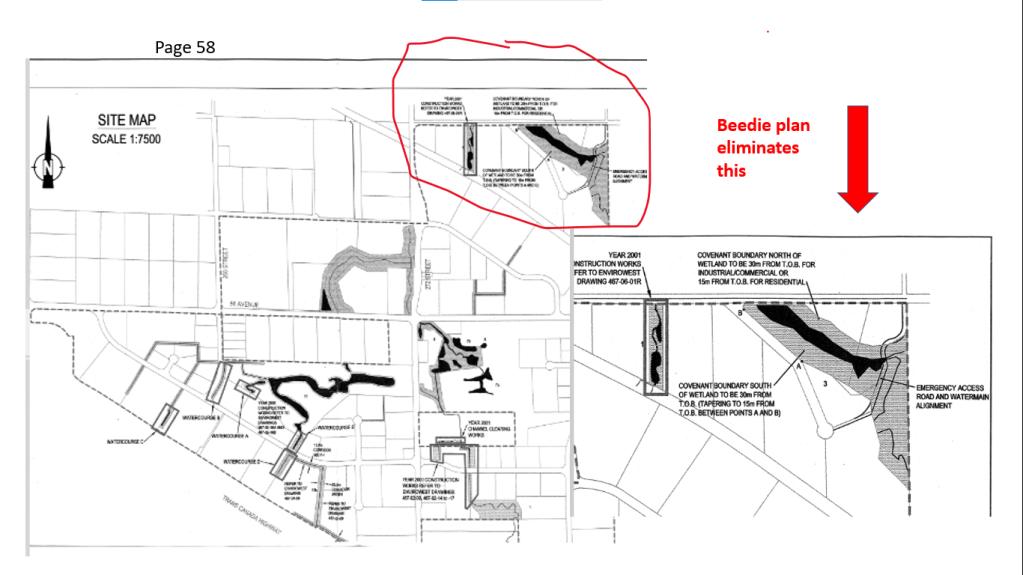
21 – HPAC -00661 LETTER OF ADVICE 275 Street and 60th Avenue

Page 119

ECCC WETLAND POLICY (accessed from CER Trans Mountain expansion hearing submissions by ECCC)
https://apps.cer-rec.gc.ca/REGDOCS/File/Download/2784996
Page 38
The Wetland Policy highlights the importance of wetlands and wetland functions for Canadians and sets out goals for conservation of wetlands as well as strategies to attain these goals. The primary objective of the Wetland Policy is to “promote the conservation of Canada’s wetlands to sustain their ecological and socioeconomic functions, now and in the future” (Government of Canada, 1991). In support of this objective, the GoC strives for the goal of no-net-loss of wetland function in certain situations (outlined in further detail herein). As a way to achieve the Wetland Policy’s primary objective highlighted above, and based on the important role that wetlands play in sustaining populations of migratory birds and species at risk, EC recommends that the hierarchy of avoidance and minimization of impacts to ecological wetland functions be broadly considered in project design. This mitigation hierarchy is recognized as best practice in environmental assessment, and recommended as a wetland conservation approach in many Canadian jurisdictions (e.g. Alberta Water Council, 2008; Nova Scotia Environment, 2011) and the United States (US Army Corps of Engineers and Environmental Protection Agency, 2008
Page 39
2.3.2.1 The Federal Policy on Wetland Conservation and the Environmental Assessment Process The key policy objectives of the Wetland Policy relevant to federal environmental assessment can be found in Strategy 2 Managing Wetlands on Federal Lands and Waters and in Other Federal Programs. These include an objective to: “Commit all federal departments to the goal of no-net-loss of wetland functions (i) on federal lands and waters, (ii) in areas affected by the implementation of federal programs where the continuing loss or degradation of wetlands has reached critical levels, and (iii) where federal activities affect wetlands designated as ecologically or socio-economically important to a region. Due to local circumstances where wetland losses have been severe, in some areas no further loss of any remaining wetland area may be deemed essential.” (Government of Canada 1991) With respect to (ii) and (iii) above, for projects on non-federal lands and waters, such losses are evaluated (1) in terms of the scope of any federal permits, licenses, authorizations and other instruments under federal jurisdiction which may be applicable, and (2) where the associated wetland functions support areas of federal jurisdiction (for EC, for example, these include migratory birds and species at risk). Although the Wetland Policy applies broadly to all wetlands
Page 40
When EC advises a Responsible Authority on the Wetland Policy, EC recommends that proponents describe the functions or natural processes of potentially impacted wetlands (physical, chemical, and biological) and perform an assessment of the potential impacts and proposed mitigation. For EC, functions of particular interest include those supporting migratory birds and species at risk. Hanson et al. (2008) ‘Wetland Ecological Functions Assessment: An Overview of Approaches’ ( http://publications.gc.ca/site/archivee-13 archived.html?url=http://publications.gc.ca/collections/collection_2010/ec/CW69-5-497-eng.pdf ) should be reviewed before undertaking a wetland functions assessment. The Wetland Policy is applied on a regional basis to reflect current conditions. The policy applies to natural, degraded, and artificial wetlands. In British Columbia, for example, the geographic areas where the documented continuing loss or degradation of wetlands has reached critical levels are defined as: • Lower Mainland / Fraser Valley region • East Vancouver Island and Gulf Islands • Okanagan Valley
Page 44
EC recommends that a detailed assessment of baseline wetland functions be completed prior to the start of Project construction for all wetlands that the Project would directly impact and for any wetland(s) that are hydrologically connected to these wetlands. In conducting this assessment, the Proponent should ensure that wetlands are considered in the context of the larger watersheds of which they are a part. Wetlands and their associated ecological functions are particularly sensitive to effects from adjacent land use, which can affect wetland hydrology and other functions. A landscape and/or watershed perspective that considers factors such as topography, soil types, and hydrological linkages should be applied, as wetlands can be impacted by activities in a watershed that may be a considerable distance.
Page 45
2.3.2.4 Temporary Loss of Wetland Functions EC advises that the Federal Policy on Wetland Conservation’s goal of no-net-loss of wetland functions also applies to temporary loss of functions. Impacts from temporary loss of wetland functions can affect migratory birds and species at risk that are dependent on wetland habitats for part of, or their entire lifecycle. For species at risk in particular, temporary impacts can exacerbate some of the effects from other existing threats and potentially jeopardize the survival and recovery of the species. EC notes that loss of wetland functions could be prolonged by the following:
1 • construction activities that occur over an extended time period, over which impacts to wetlands would be expected to occur;
2 • limitations related to infrequency of monitoring of wetland recovery, which includes
3 identifying the need to implement additional reclamation measures, e.g. proposed to
4 occur in the first growing season post construction but limited to bi-annually after this
5 time (Exhibit B239-27, PDF page 9);
6 • compensation measures that are implemented only after year 5 of the Wetland
7 Function Post-construction Monitoring Program, when the need for compensation
8 would be evaluated and confirmed; and
9 • the timeframe within which functions of the compensated wetland would achieve an
10 equivalent, or higher, level than the functions lost from the original wetland
 Education
Leave a comment